- Stop at unexpected resistance
- Review records and scan location
- Resolve the attachment design
Reddit discussions identify questions; technical guidance comes from the linked primary sources. This article is not a site inspection or an engineered specification. How we research.
A drill suddenly stops progressing, and metal appears at the bottom of the hole. The tempting response is to find a stronger bit. That treats the obstacle as a tool problem before establishing what the obstacle is.
A Reddit garage-floor drilling question asked whether the visible metal could simply be drilled through. Comments confidently identified and dismissed the object, but a photograph cannot establish the complete slab system or the importance of what was encountered.
Stop and preserve the information
Record the hole location, intended diameter and depth, approximate depth reached, and what changed during drilling. Keep the attachment layout and anchor information available.
Do not enlarge the hole to obtain a better view or probe adjacent locations casually. Further cutting can destroy information and create additional uncertainty.
If there are signs of an affected service, follow the appropriate emergency or site procedure. Otherwise, keep the work paused while the relevant records and qualified assessment are obtained.
Identify the slab system
Look for structural drawings, as-built information, slab markings, previous scan records, and building documentation. Determine whether the element is a slab on grade, suspended slab, precast component, or another construction type.
The absence of an obvious warning mark is not proof that no tendon or service exists. Likewise, a familiar building type does not establish the contents of every local area.
For post-tensioned construction, the Post-Tensioning Institute's guide to openings and penetrations describes a comprehensive process. That is a fundamentally different undertaking from selecting a bit at a hardware store.
Use scanning as evidence, not magic
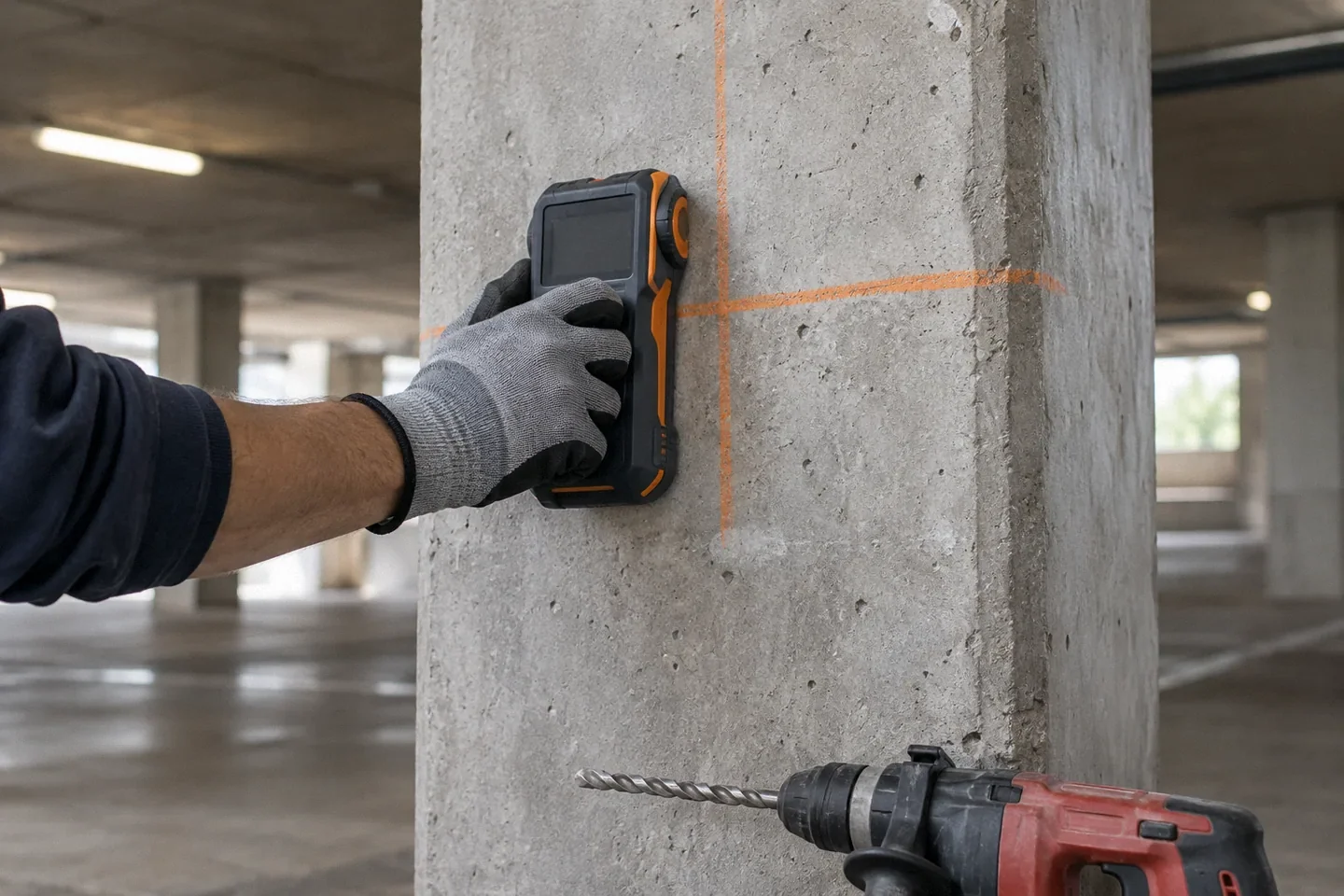
A suitable scan can help locate embedded objects and establish information about their positions. The Hilti PS 1000 documentation lists reinforcement, tendons, and conduits among its applications and notes that performance depends on site conditions.
Ask the scanning provider what the result establishes and what remains uncertain. Depth, object spacing, material, access, and the equipment's limitations can affect interpretation.
A marked clear area is useful only in relation to the planned hole's diameter, depth, and location. Give the provider the actual attachment or penetration plan rather than requesting a generic scan with no defined purpose.
A hypothetical garage anchor
Suppose an owner is installing a floor-mounted attachment and encounters metal before reaching the anchor's required depth. They consider moving the hole slightly sideways.
Before doing so, they gather the anchor instructions and the mounting pattern. The proposed move may affect the attachment, spacing, or distance from an edge. It may also remain over the same embedded object.
The next step is to identify the slab and concealed conditions, then have the attachment layout reviewed as needed. A different anchor or location may be possible, but it should be a documented choice rather than a sequence of exploratory holes.
This example deliberately does not prescribe an anchor or drilling depth. Those depend on the actual load, substrate, product, and structure.
Keep the object and the attachment as separate questions
Even if the obstruction is identified as reinforcing steel, that does not automatically authorize cutting it. Its role must be understood in the relevant design.
Even if a revised location avoids the object, the anchor installation still needs to meet its own requirements. A clear drilling path and a suitable attachment are both necessary.
| Question | Evidence to gather |
|---|---|
| What is the slab? | Drawings and construction information |
| What was encountered? | Qualified investigation and scan interpretation |
| What does the hole need to do? | Attachment loads and product requirements |
| Can the location change? | Revised layout reviewed against those requirements |
| Who authorizes structural changes? | Responsible project professional |
| What is recorded afterward? | Final location and relevant installation records |
This separation prevents a common error: solving the obstruction while creating an unsuitable connection.
Do not use drilling feel as identification
A change in resistance can be a useful observation, but it cannot reliably classify every embedded object. A handheld magnet or metal shavings also do not reveal the object's structural role.
Internet advice that “rebar does nothing in that kind of slab” is not a substitute for examining the actual design. General statements can be particularly misleading for suspended, prestressed, or unusual construction.
If structural reinforcement or a tendon may be involved, obtain the relevant professional assessment. This article does not provide instructions for cutting, detensioning, or repairing those systems.
Plan dust control too
For US construction employers, OSHA's handheld and stand-mounted drill fact sheet describes task-specific silica controls. Follow the applicable requirements and tool instructions rather than assuming a small number of holes produces no concern.
Dust management does not resolve the concealed-object problem, but both belong in the job plan. The same applies to access, electrical supply, and the manufacturer's drilling and hole-cleaning procedure.
For a hired installer, ask how these matters are handled as part of the work. A competent attachment plan should not begin and end with the bit diameter.
Resume only with a clear decision
Before restarting, establish the permitted location, depth, method, and attachment requirements. Identify who resolved any structural or service uncertainty.
Retain the scan information and final layout. They can help future work, although future penetrations still need their own review.
The immediate action after encountering unexpected metal is simple: stop and identify. The subsequent decision should be based on the slab and connection, not on which bit can cut the obstacle.
Frequently asked questions
Can I move the hole slightly and try again?
Not without reviewing the new location. Both concealed objects and anchor requirements can still be affected.
Does scanning guarantee a safe hole?
No. It provides evidence subject to limitations. Use competent interpretation and any required structural or service review.
Research references
- primary · search-excerpt
PTI DC80.2-10 Guide for Creating Openings and Penetrations in Existing Slabs with Unbonded Post-Tensioning - primary · full
Hilti PS 1000 X-Scan - primary · search-excerpt
OSHA Handheld and Stand-Mounted Drills Silica Fact Sheet - reddit · search-excerpt
What did I just hit while drilling?