- Map deposit recurrence
- Investigate water pathways
- Verify finish readiness afterward
Reddit discussions identify questions; technical guidance comes from the linked primary sources. This article is not a site inspection or an engineered specification. How we research.
The recurrence matters more than the first cleanup
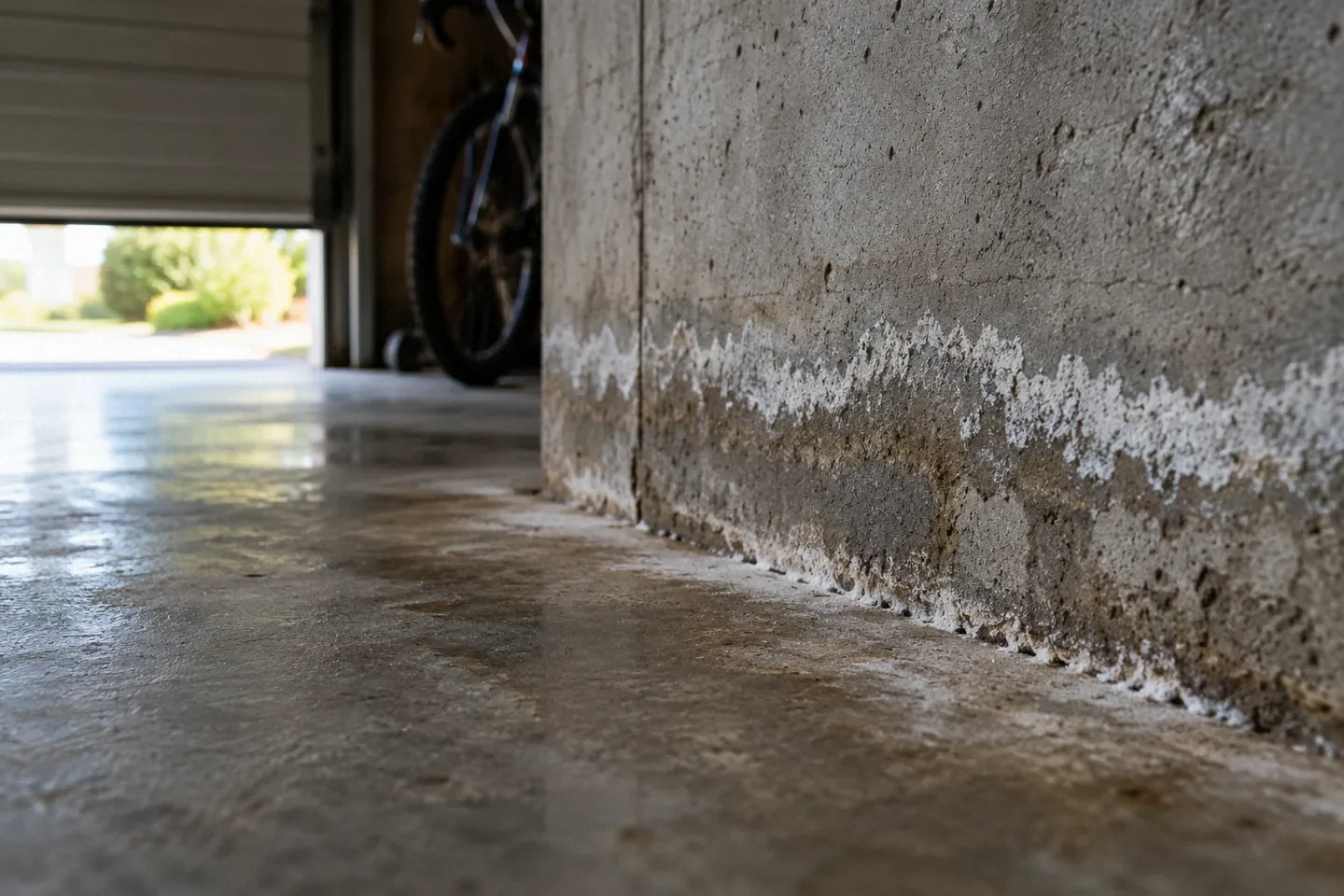
A garage owner notices white material beside a wall, sweeps it away and sees it return after the next wet period. The repeated pattern is more useful than an isolated photograph. It suggests a continuing condition worth documenting before a decorative floor system makes the concrete harder to inspect.
A Reddit owner of a below-grade garage described repeated water entry and white deposits. Another thread concerned deposits at a new basement perimeter seam. These are different settings, but both illustrate the same planning issue: identify the material and moisture history before treating the floor as a blank canvas for coating.
Identify the deposit without assigning a water source
Efflorescence can result when water transports soluble material to a surface, as explained in Euclid Chemical's technical bulletin. Confirming that type of deposit still does not tell you exactly where the water originated. It may require a separate investigation.
Do not infer the absence of a vapor retarder from a photograph. The slab's age, drawings and construction records may provide context, but the deposit itself is not a view beneath the concrete. Similarly, a visible seam is not automatic proof that water enters only at that seam.
If the material could be a different residue or biological condition, obtain suitable identification rather than treating every white appearance as harmless salt. This article does not provide a visual test that excludes other possibilities.
Build a recurrence map
Sketch the garage and mark the deposit locations, wall boundaries, cracks, doors, drains and stored items. Record dates of cleaning and reappearance. Note rainfall, irrigation, washing or plumbing events when known. Keep observations factual and avoid filling gaps with assumptions.
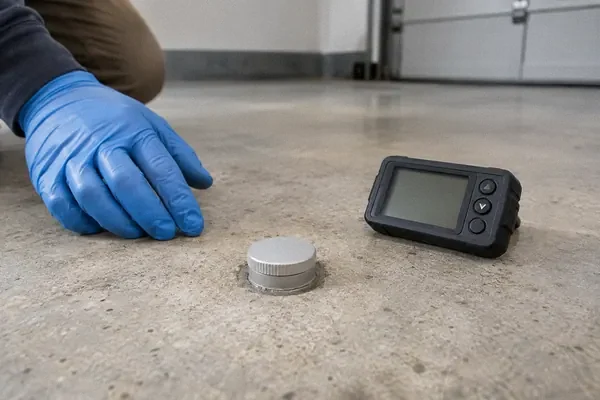
Photograph the same locations under similar conditions. Include an unaffected comparison area. If a cabinet or appliance concealed the deposit, record that context before moving everything and losing the original arrangement. Do not deliberately flood the area to reproduce the problem.
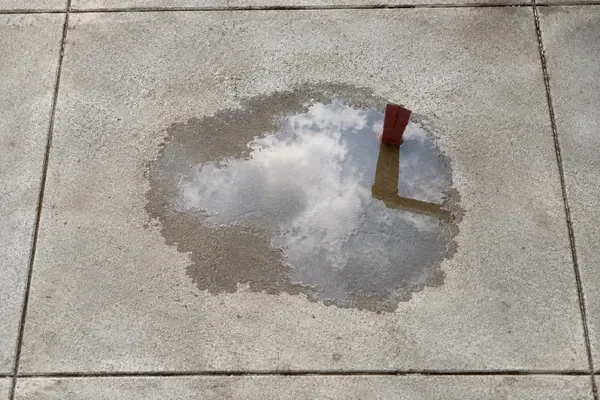
Also distinguish visible water from a damp-looking surface. Standing water after a storm, a wet wall and a dark patch are different observations. Each can guide the contractor, but none should be silently converted into a precise diagnosis of vapor transmission or water pressure.
Investigate visible water entry as its own problem
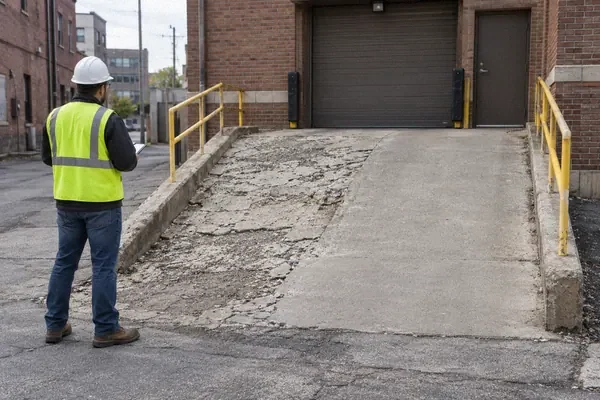
If water is entering during rain, examine the relevant building and drainage conditions with an appropriate contractor. The investigation may include exterior grade, downspouts, thresholds, joints or other pathways. The closest visible feature is not necessarily the only source.
Ask for a description of the proposed correction and where water will go afterward. A surface coating should not be offered as a complete substitute for a drainage or enclosure repair without a supported explanation. The owner needs to know which pathway the work addresses and which uncertainties remain.
After corrective work, agree on how performance will be observed. A dry day immediately after the repair does not reproduce the condition that caused the complaint. The review should use an appropriate observation plan without manufacturing a harmful test.
Moisture readiness for a finish is another decision
Even after a visible leak or runoff problem is addressed, a proposed coating still has its own substrate requirements. NRMCA CIP 28 discusses slab moisture in relation to finishes. Ask the coating installer to identify the required tests and acceptance limits for the complete system.
NRMCA CIP 29 provides context about vapor retarders under slabs. It is useful background for understanding why construction history matters, but it does not establish the condition of a particular existing membrane. Unknown history should be considered in the finish plan rather than ignored.
Do not treat the disappearance of powder as a moisture test. Cleaning may remove the visible evidence without establishing that the floor is ready for a moisture-sensitive coating. Conversely, a test result needs to be interpreted within its method and conditions, not as a permanent guarantee against every future water event.
Cleaning belongs after identification
Once the material and finish are understood, select a compatible cleaning process. PROSOCO's Light Duty Concrete Cleaner information is one example of manufacturer guidance for specified deposits and substrates. Follow the exact product requirements and use a suitable trial rather than an improvised acid treatment.
Document the cleaned area and any recurrence. If a coating is planned, coordinate the cleaner with the coating system's preparation requirements. Residue from a poorly coordinated cleaning step can become another uncertainty for the installer.
Ask whether the cleaning is intended only to improve appearance or also forms part of preparation for the next finish. Those scopes may overlap, but they should not be confused.
Keep the three work stages distinct
| Stage | Completion evidence to request |
|---|---|
| Water investigation and correction | Findings, defined work and an appropriate follow-up observation. |
| Deposit removal | Identified material, compatible method and dry-condition result. |
| Coating readiness | System requirements, test results and prepared-substrate acceptance. |
A single contractor may coordinate all stages, or several trades may be involved. In either case, designate who confirms the handoff so one trade does not assume another resolved an unanswered condition.
A hypothetical garage restoration
Imagine a hypothetical garage where white deposits repeatedly appear behind stored boxes after storms. The owner wants epoxy to simplify cleaning. The project first documents the pattern and investigates visible water entry. After defined corrective work, the floor is cleaned and the selected coating's readiness checks are performed.
If those checks require additional measures, the owner can evaluate them with the earlier findings available. If the system is unsuitable, a different finish or delayed installation can be considered. The sequence prevents the attractive final coating from becoming the first experiment in a still-unresolved moisture problem.
Keep the floor visible until the key questions are answered
Request a coordinated plan and preserve the deposit map, water findings and finish records. Recurring white material does not automatically condemn a slab, but it should not be repeatedly hidden without explanation. Resolve the moisture question, clean appropriately and establish readiness for the chosen finish as three connected, documented decisions.
Related questions
Will epoxy stop recurring garage efflorescence?
Do not assume a coating solves the moisture source. Establish the condition and the coating system's limits before covering the floor.
Does a white deposit prove the vapor retarder is missing?
No. The deposit alone cannot identify the slab's construction or the water pathway. Records and appropriate evaluation are needed.
Research references
- primary · search-excerpt
Euclid Chemical Technical Bulletin CP-30: Efflorescence Causes, Prevention, and Removal - primary · full
NRMCA CIP 28 - Concrete Slab Moisture - primary · full
NRMCA CIP 29 - Vapor Retarders Under Slabs on Grade - primary · search-excerpt
PROSOCO Light Duty Concrete Cleaner - reddit · search-excerpt
Is this efflorescence? Why has so much of it collected? - reddit · search-excerpt
White efflorescence?