- Record the mat outline
- Identify the sealer history
- Evaluate a fully dry test area
Reddit discussions identify questions; technical guidance comes from the linked primary sources. This article is not a site inspection or an engineered specification. How we research.
The outline is a clue, not the full answer
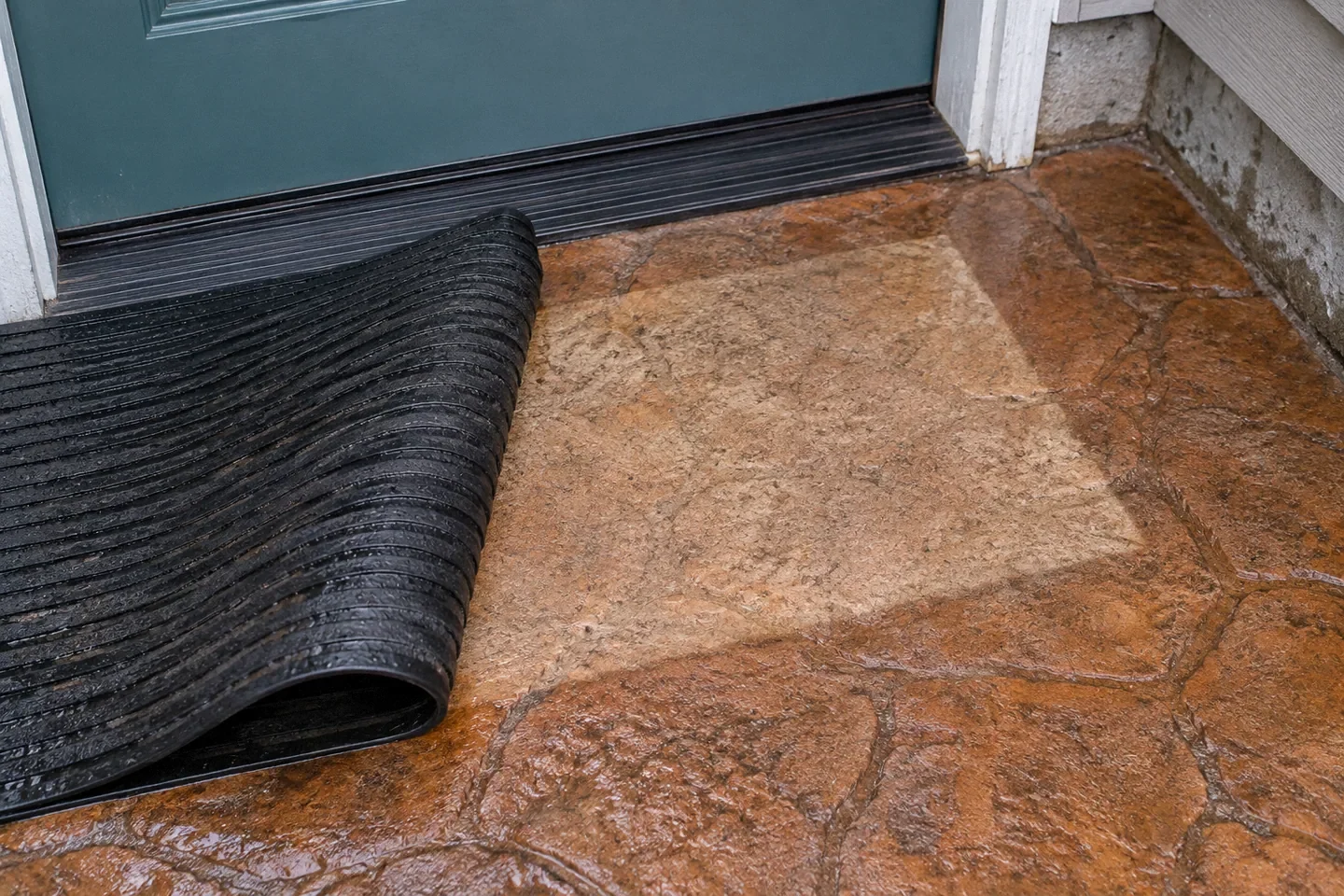
A barbecue mat or outdoor rug is moved and leaves a pale rectangle on stamped concrete. Because the shape matches the mat, it is tempting to assign a single explanation immediately. The outline does establish where conditions differed from the surrounding surface. It does not establish whether the visible change is in a deposit, the sealer or the decorative concrete itself.
A Reddit homeowner described white marks after removing barbecue mats and wondered whether they were efflorescence. The discussion quickly moved toward cleaning chemicals. A better first step is to establish the finish history and observe the uncovered area under comparable dry conditions. The thread cannot confirm the identity of the marks.
Record what was covering the surface
Note the mat's material if known, how long it was in place, whether water regularly reached it and whether it lay flat against the surface. Record nearby sprinklers, roof runoff or cleaning practices. These details help the evaluator understand the exposure without assuming that one particular mat material always causes the same problem.
Photograph the whole outline and several details before cleaning. Include an adjacent area that was never covered. If there are several mats, compare them: did all locations change, or only one? Differences in shade, runoff or surface treatment may be useful clues.
Avoid placing the mat back over a wet area simply to reproduce the mark. Document the existing situation and ask the installer or manufacturer how the surface should be left while it is evaluated. The goal is to preserve evidence without continuing an unwanted condition.
Identify the coating before choosing a remedy
Stamped concrete may have color and one or more protective treatments. Request the full sealer name and any recoating history. A generic description such as acrylic or wet look can help narrow the discussion but may not be enough to select a repair method.
Euclid's sealer troubleshooting guidance discusses whitening associated with moisture and film conditions. Its broader curing and sealing troubleshooting article also addresses recurring film problems. These sources explain why another coat should not be the automatic response to a cloudy patch.
If no product record exists, ask how the contractor will evaluate the unknown finish. Do not let an uncertain coating history become an unmentioned assumption. A test may be needed before any full-area cleaning, stripping or replacement treatment is priced confidently.
Separate residue from a changed film
Describe whether the mark appears powdery, smooth, blistered, peeling or simply lighter. Do not scrape aggressively to decide. A small professional examination or compatible test can be more informative than a large damaged patch created during investigation.
If mineral deposits are suspected, the water history still matters. Euclid explains the transport of soluble material in its efflorescence bulletin. That mechanism is not the same as a cloudy film, and a treatment suited to one may not suit the other.
Ask whether both conditions could be present. A covered location can contain an old coating, residue and an ongoing wetting pattern. A useful scope identifies what will be treated and what exposure will need to change afterward.
Design a test that can fail safely
Choose a discreet portion of the affected area and document it. Agree on the exact product and method, who performs the test and how long the area needs before evaluation. The test should use the intended full-job process, not a different shortcut used only for demonstration.
Review the result after drying. Look at color, gloss, texture and the boundary between treated and untreated areas. Ask whether a successful small test can be expanded without leaving a visible halo or changing the decorative finish elsewhere.
Do not evaluate only the first few minutes, when the area may look darker because it is wet. A temporary improvement is not the same as an acceptable completed repair. If the mark returns or the finish changes undesirably, the test has provided useful evidence to stop and reconsider.
Questions for the contractor or manufacturer
- Which coating and color system is present?
- Is the observed change a deposit, film condition or substrate change?
- What evidence supports that identification?
- Is the proposed cleaner or treatment compatible with the finish?
- What will the test area demonstrate after drying?
- Will the repaired area match surrounding gloss and color?
- What mat or covering guidance applies to the chosen system?
- Which wetting conditions should be corrected before replacement covering?
Keep the answers with the product information. Future owners or maintenance contractors will benefit from knowing what was applied and why.
A hypothetical outdoor-kitchen example
Imagine a hypothetical stamped patio with a white rectangle beneath a grill mat. The surrounding concrete has been resealed twice, but the owner does not know the product. The owner proposes an acid cleaner based on a forum comment. A cautious contractor first obtains the sealer record and tests a compatible method in a small area.
The test may show a coating-related issue rather than a removable mineral deposit. That changes the treatment and the discussion about future covering. Alternatively, a confirmed deposit may respond to an appropriate cleaning process while leaving the original coating acceptable. The mat outline alone could not choose between those outcomes.
Prevent another uncertain repair cycle
After the surface is restored, follow the finish manufacturer's guidance about mats, coverings, cleaning and maintenance. Address repeated wetting where practical and inspect beneath movable items periodically under a sensible maintenance plan. Do not promise that every mat can be used safely on every finish. The durable improvement is a known coating system, a tested remedy and clear instructions for how the area will be used afterward.
Related questions
Do white marks under a mat prove efflorescence?
No. Deposits, trapped-moisture effects and coating problems can look similar, so the finish history matters.
Can I hide the mark with another sealer coat?
Do not assume that is suitable. Identify the existing system and cause first, then test a manufacturer-supported treatment.
Research references
- primary · search-excerpt
Euclid Chemical: Diagnosing 5 Common Concrete Sealer Problems - primary · search-excerpt
Euclid Chemical: Demystifying Curing and Sealing, Part 4, Product Selection and Troubleshooting - primary · search-excerpt
Euclid Chemical Technical Bulletin CP-30: Efflorescence Causes, Prevention, and Removal - reddit · search-excerpt
White spots appeared after packing away BBQ mats on stamped concrete