- Check substrate and protection plan
- Monitor concrete conditions
- Release protection by requirements
Reddit discussions identify questions; technical guidance comes from the linked primary sources. This article is not a site inspection or an engineered specification. How we research.
Cold-weather planning often stops at the truck: order warm concrete, include an accelerator, and pour while the afternoon feels comfortable. The concrete remains on site after the truck leaves, so the more important plan extends through the following nights and the removal of protection.
A Reddit owner asked about a slab poured during a Canadian winter. They had temperature observations and insulation information but were unsure how to interpret the required duration. That is precisely why protection criteria should be agreed before placement.
Use the project's requirements, not a universal day count
NRMCA CIP 27 explains the effects of cold conditions and the need to protect young concrete from freezing. Its guidance connects protection with strength development, rather than treating the calendar alone as proof of readiness.
Use the applicable current project specification and responsible professional's direction for the actual work. An older guide's general weather definition should not replace the requirements adopted for a particular project.
Ask what evidence will establish that protection may change or end. The answer might involve specified testing, temperature records, or another approved method appropriate to the project.
Prepare the receiving conditions
Review the substrate, forms, reinforcement where present, and the exposure of the element. A favorable air temperature at midday does not establish that every receiving surface is suitable.
Discuss how the work area will be prepared and maintained before concrete arrives. If conditions change overnight, inspect again instead of relying on yesterday's readiness check.
Avoid placing concrete on an unresolved unsuitable substrate merely to meet a delivery appointment. The mixture cannot compensate for every preparation problem.
Coordinate the mixture with the work
The producer can help supply a mixture suited to the project's requirements and conditions. Explain the planned placement duration, element, and finish.
An accelerator may influence setting or early strength development, but it is not antifreeze. Keep that distinction explicit in the order discussion.
Also consider the crew's capacity. A mixture that changes the expected working rhythm needs a compatible placing and finishing sequence. Do not select it solely because it carries a winter-related description.
A hypothetical overnight protection plan
Imagine a small exterior slab placed on a cool day with freezing conditions expected overnight. The contractor has insulating covers but has not assigned anyone to inspect or monitor the work after leaving.
The missing item is responsibility. The team needs to establish what is monitored, where information is collected, who reviews it, and what happens if conditions depart from the plan.
The slab's edges and other exposed areas may require attention different from the protected center. A single convenient observation should not be assumed to represent the entire element.
This example does not prescribe a blanket arrangement or monitoring schedule. It shows why materials alone are not a complete protection system.
Write down the protection sequence
| Stage | Question to resolve |
|---|---|
| Before placement | Are receiving surfaces and materials ready? |
| Delivery | Does the mixture meet the project requirements? |
| Finishing | Is the crew prepared for the expected behavior? |
| Initial protection | What system is installed and by whom? |
| Monitoring | What observations or measurements are required? |
| Unexpected conditions | Who acts and what resources are available? |
| Removal | What criteria and transition method apply? |
Keep the sequence short enough to use, but specific enough that responsibility does not vanish when the crew leaves.
Do not confuse setting with readiness for loading
Concrete becoming firm enough for one operation does not establish readiness for every later load. Form removal, walking, construction traffic, and intended service loading can involve different requirements.
Ask the responsible party to identify the relevant criterion for each planned activity. A fixed statement such as “it is hard tomorrow” is too vague to authorize heavy use.
Do not infer strength from surface feel alone. If the project requires verification, arrange that process before the decision becomes urgent.
Manage the end of protection too
Removing insulation or other protection changes the concrete's environment. The transition belongs in the plan rather than being treated as simple cleanup.
NRMCA discusses avoiding abrupt temperature changes. Use the project's appropriate procedure for reducing or removing protection.
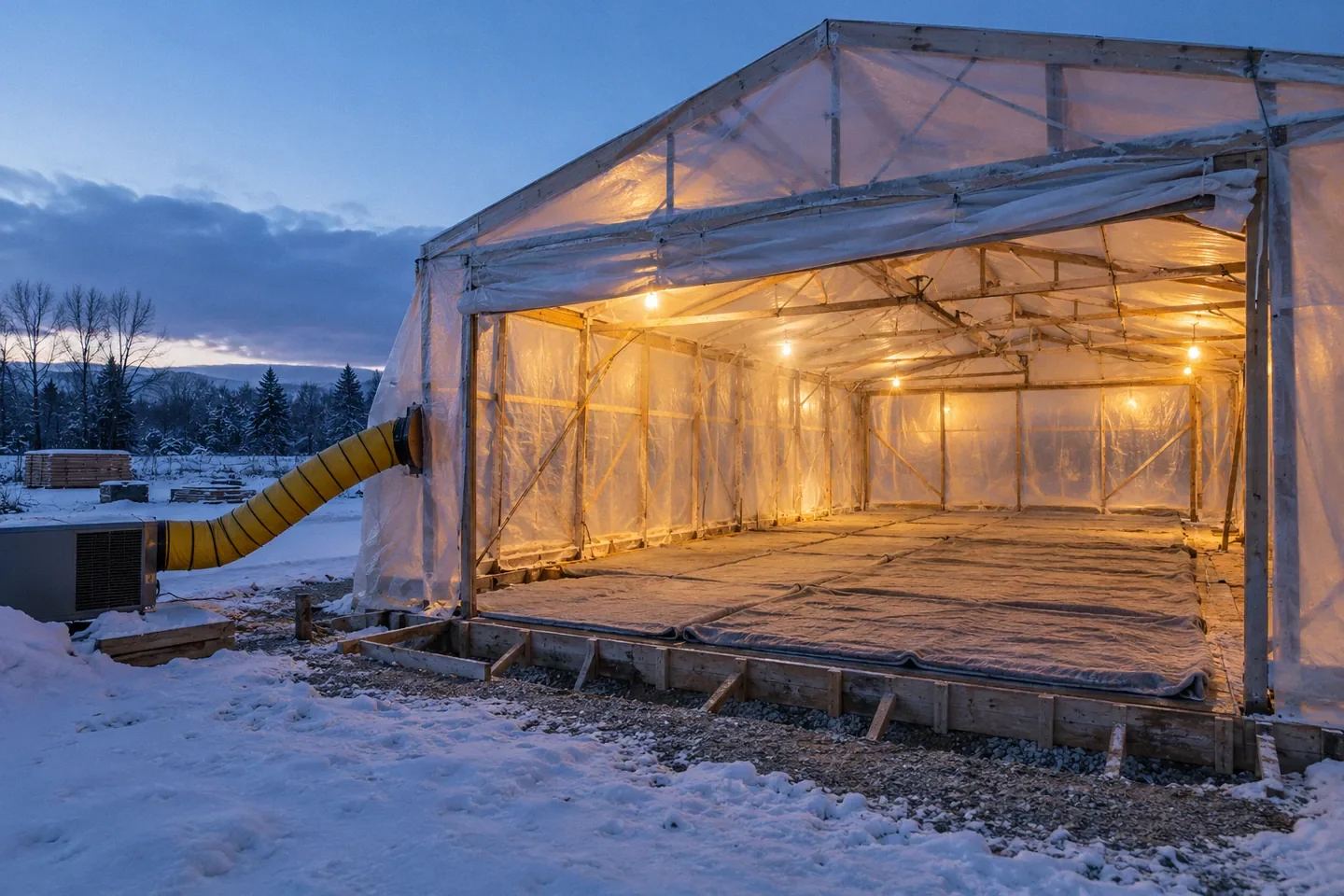
If heating equipment is part of the plan, it also requires suitable equipment, operation, and site controls. Do not improvise a heater arrangement around fresh concrete based on a casual online suggestion.
Keep records useful and proportionate
Retain the mixture information, placement time, relevant weather observations, monitoring records, and decisions about protection. These records help establish what actually happened.
They do not automatically prove a defect or guarantee performance. Their value is to support an informed assessment if questions arise.
For a homeowner responsible for checking covers or maintaining access, obtain clear instructions and an escalation contact. Do not accept a vague obligation to “keep it warm” without understanding the method and limits of your role.
Decide whether the resources are available
Cold-weather work can be feasible, but feasibility depends on the actual system, people, and verification. If the required resources are unavailable, rescheduling may be more sensible than relying on optimism.
The immediate planning task is to ask what happens after finishing, through the coldest period, and during protection removal. A good answer connects the mixture, site conditions, monitoring, and release criteria.
Frequently asked questions
Are two days under a blanket always enough?
No. Use the applicable protection and strength criteria rather than a universal duration.
Does a warm delivery mean insulation is unnecessary?
Not by itself. Delivered temperature is only one part of the subsequent protection plan.
Research references
- primary · full
NRMCA CIP 27 Cold Weather Concreting - reddit · search-excerpt
Question about concrete poured in cold weather