- Confirm the specified curing method
- Identify who maintains it
- Get a written handoff
Reddit discussions identify questions; technical guidance comes from the linked primary sources. This article is not a site inspection or an engineered specification. How we research.
Ask what system is already being used
A homeowner sees a fresh driveway and receives conflicting instructions: spray it every few hours, keep it continuously wet, cover it, or leave the contractor's treatment alone. The first useful question is what curing system was specified and actually installed. Without that answer, a watering schedule can conflict with an existing plan or leave important responsibilities undefined.
A Reddit homeowner asked whether intermittent watering caused patio cracks after receiving instructions to wet the surface at intervals. The responses disagreed about the value of curing and coverings. That discussion shows why the handoff should be explicit. It does not establish the cause of the owner's cracks or a schedule for another project.
Curing is about conditions, not a ritual
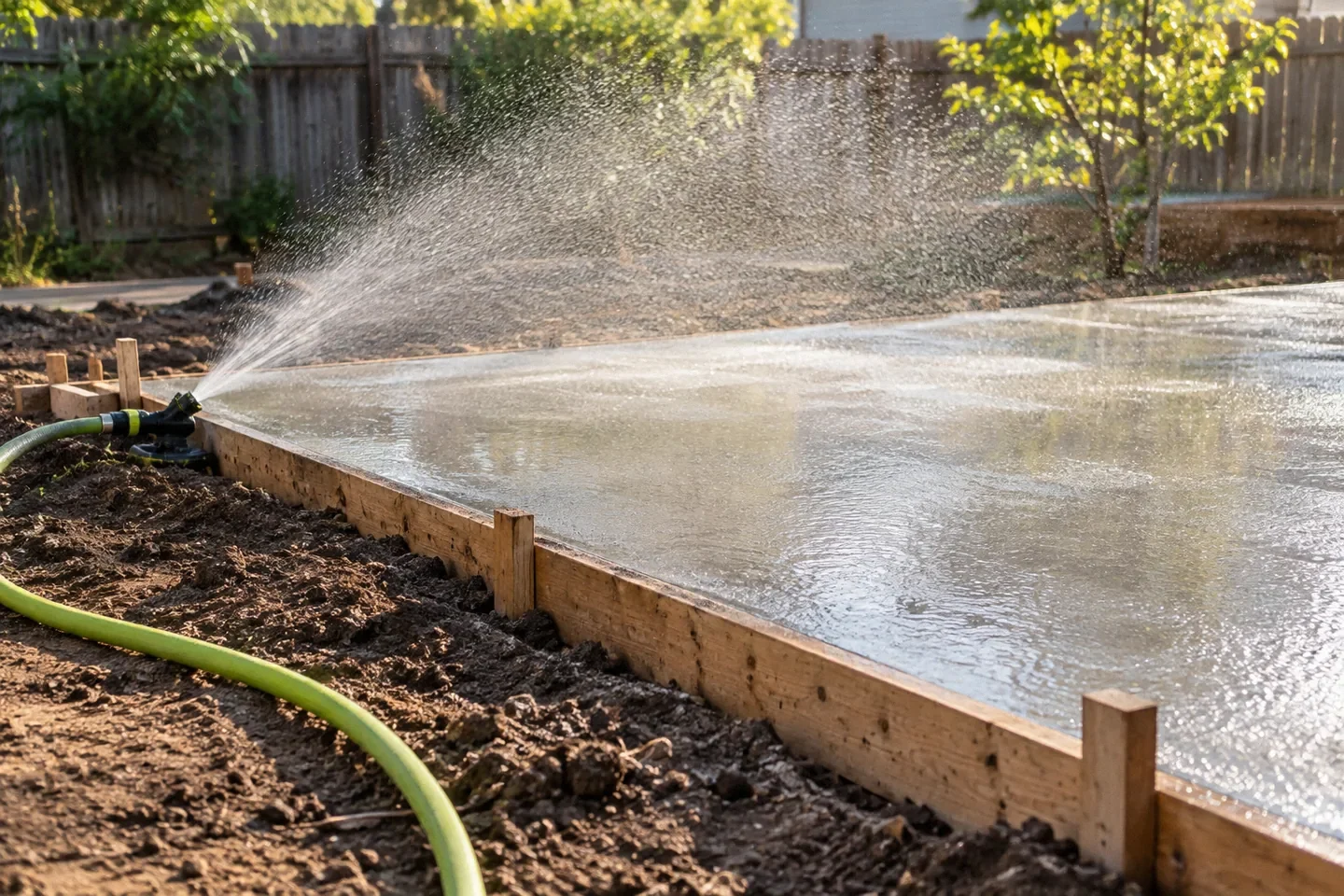
Curing supports development of the concrete's intended properties by managing moisture and temperature. In CIP 11, Curing In-Place Concrete, NRMCA distinguishes methods that supply water from methods that retain it and rejects alternating wetting and drying as a water-curing practice. The practical implication is straightforward: the objective is not to count hose visits.
A brief spray followed by hours of drying should not be assumed equivalent to an appropriate continuous moist-curing method. At the same time, the homeowner should not improvise ponding, attach covers or begin spraying immediately without knowing when the surface can tolerate the method and what the contractor intended.
Ask for a plan that fits the actual slab, finish, weather and available supervision. A method that depends on attention no one can provide is a weak plan, even if it sounds ideal in theory. Resolve that before placement when possible; after placement, clarify it promptly with the installer.
Separate the crew's work from the homeowner's handoff
The period during placing and finishing is not the same as the aftercare period. Ask when the crew's protection ends, when final curing begins and what the homeowner is expected to maintain. If a product was applied, request its name and the relevant instructions. The word sealer does not explain whether it was intended as a curing treatment, a later protective finish or both.
Write down who checks coverings, water supply or other measures, and what to do if they are disrupted. A text message confirming the plan can prevent later confusion about whether the owner was supposed to water, avoid water or simply protect the area from traffic.
Also ask when the area can be used. Curing care and return-to-use instructions are related but distinct. Do not infer vehicle readiness from a surface that looks dry or from the date when a covering is removed. Get project-specific instructions rather than borrowing a number from a different installation.
Weather changes the practical demands
A sunny, windy location may not behave like a shaded one. Observe what is happening to the actual surface and communicate concerns to the installer. Do not assume that a cool air temperature means the surface cannot lose moisture, or that hot weather automatically explains every crack.
If rain is expected, ask how the curing method will be maintained and how runoff will be managed. Rainfall is not a complete written curing plan because its timing and distribution are outside the contractor's control. Likewise, a sprinkler that misses corners may not provide the intended uniform condition.
The installer should explain how the selected method handles the site's conditions. Your role is to follow and document that plan, not independently redesign it while the concrete is young.
A handoff checklist worth keeping
Before the crew leaves, obtain answers to these practical questions:
- What exact curing method is in place?
- When did it begin, and how long is it intended to continue?
- Who is responsible for maintaining it each day?
- What signs indicate that a covering or water supply needs attention?
- What should happen if the weather changes or the system is interrupted?
- Are any existing products incompatible with extra treatment?
- When may people, furniture and vehicles use the area?
- Who should receive photographs if a concern appears?
This is not excessive paperwork for a small slab. A short, coherent set of instructions is easier to follow than several casual remarks made during cleanup.
What if the surface dried between watering?
Record the interruption and contact the installer. Avoid immediately concluding that the concrete is ruined or that any visible line must result from that event. The significance depends on the actual conditions and timing. A later evaluation may need to distinguish appearance, surface soundness and cracking.
Do not respond by applying an unfamiliar chemical or aggressively flooding a still-sensitive surface. Ask whether the original plan should continue or change. Keep the conversation factual: when the interruption occurred, what the surface looked like and what instructions were followed.
If there is already a crack, document it separately. Continuing appropriate curing is not a promise that an established crack will close, and the presence of a crack does not make further care pointless. Those are separate parts of the project response.
A hypothetical scheduling problem
Suppose a hypothetical homeowner is told to water a large patio regularly but works away from home all day. The instructions depend on attention the owner cannot provide. Before the pour, a useful discussion would select an appropriate method that can actually be maintained and assign responsibility for it.
If the conflict becomes apparent only after placement, the owner should notify the installer immediately and obtain a revised plan. Quietly substituting a few evening hose passes leaves both the method and expectations uncertain. The important improvement is a coordinated, workable handoff.
Finish with one set of instructions
Keep the final plan and product information in the project file. If instructions change, record the new version and who provided it. Good aftercare is easier when everyone understands the same objective and responsibilities. Confirm the method first, maintain it as specified and report interruptions promptly rather than trying to reconcile contradictory internet schedules on your own.
Related questions
Should every new driveway be watered?
Not every project uses water curing. Ask whether a membrane, covering or another specified method is already in place and follow the coordinated plan.
Did one missed watering ruin the slab?
That cannot be concluded from a missed interval alone. Document what happened and ask the installer whether the curing plan needs adjustment or evaluation.
Research references
- primary · full
NRMCA CIP 11 - Curing In-Place Concrete - reddit · search-excerpt
Was this crazing due to curing method?