- Name the exact fiber product
- Identify its intended function
- Require design-backed substitution
Reddit discussions identify questions; technical guidance comes from the linked primary sources. This article is not a site inspection or an engineered specification. How we research.
A contractor says the patio will contain fiber, so rebar is unnecessary. Another says every slab needs steel. Both statements are too broad to settle a specific proposal. Start by identifying what “fiber” means and what the reinforcement is supposed to accomplish.
A Reddit patio owner received exactly this fiber-versus-rebar claim. The discussion quickly mixed different fiber types and different kinds of slabs. That is why the product and design basis matter more than the label.
Ask for a name and a function
Request the manufacturer's product name, fiber category, proposed dosage, and intended role. The answer should distinguish a product used to address early plastic behavior from a system intended to provide a designed post-cracking contribution.
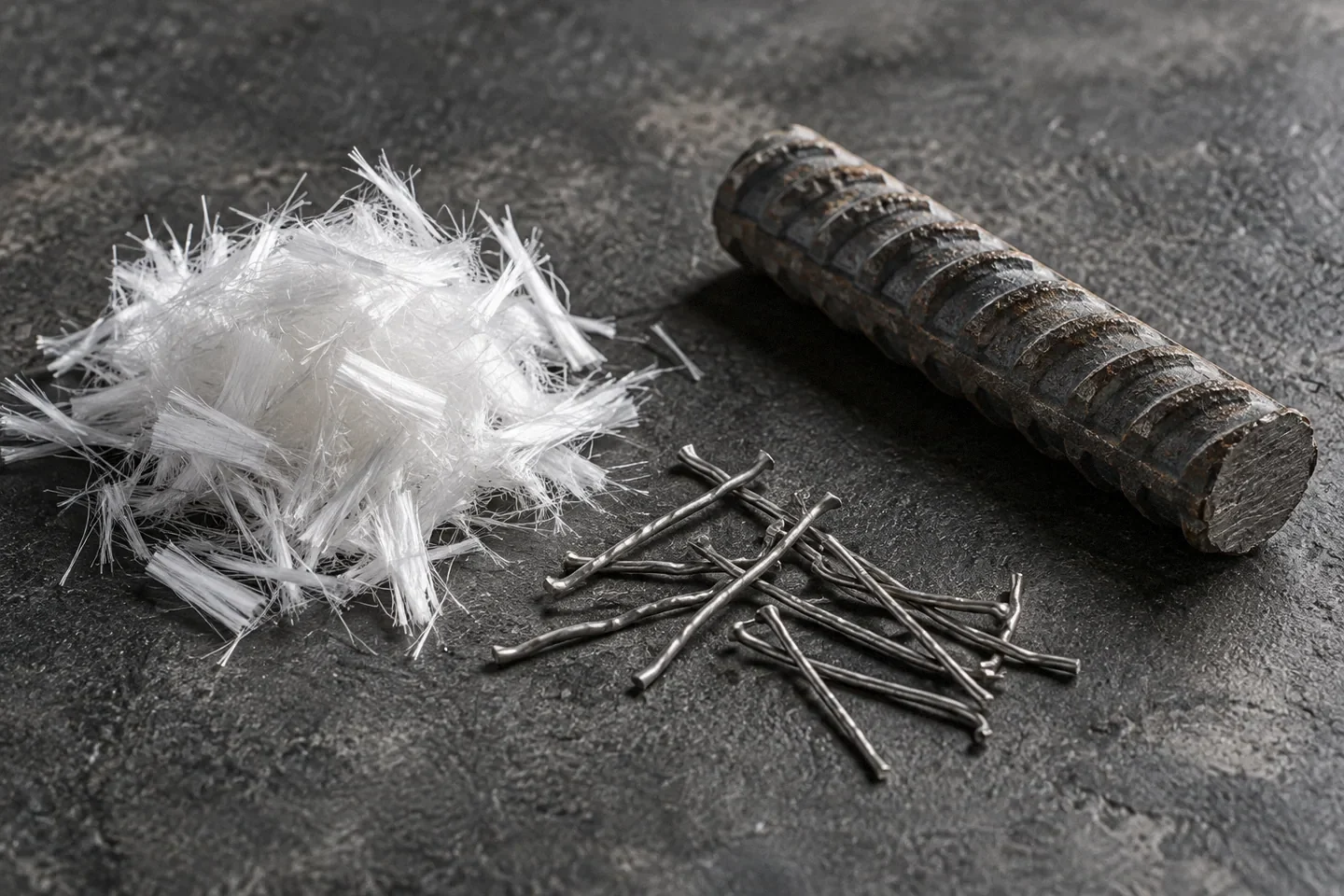
NRMCA CIP 24 explains important distinctions among synthetic fibers. Its central value for a buyer is that “fiber concrete” is not one universal material with one universal replacement rule.
Do not infer performance from how conspicuous the fibers look. Fine fibers and larger fibers may differ in more than appearance. Likewise, a high number of fibers per bag is not a substitute for the manufacturer's relevant performance information.
Identify what is being replaced
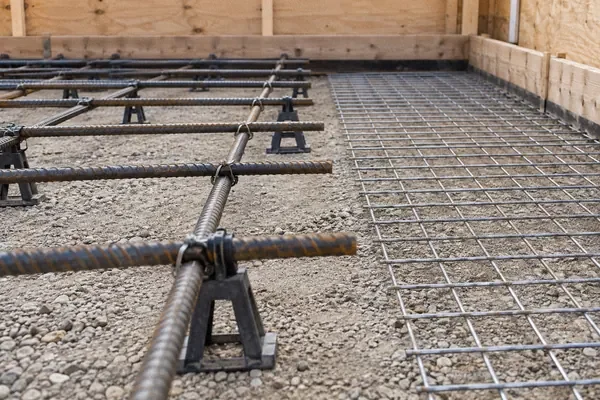
Sometimes a proposal replaces welded wire reinforcement. Sometimes it removes a designed bar arrangement. Sometimes the original slab was not specified to contain either, and fiber is an additional choice. Those are three different discussions.
Find the actual baseline. Ask whether the quote is based on a drawing, a designer's detail, a local standard, or the contractor's customary method. If an approved design specifies reinforcement, a substitution should be evaluated through the appropriate design process.
Do not use CIP 24 as authority to replace structural or moment-resisting reinforcing steel. A documented fiber proposal must identify its applicable nonstructural shrinkage-and-temperature or designed post-cracking role; structural substitutions require a separate appropriate engineering design and approval.
A verbal claim that fiber is “stronger” does not identify the comparison. Stronger in what behavior, at what dosage, in which slab, and under what test or design method? A useful answer names the relevant function.
Do not reduce the whole slab to reinforcement
Support conditions, geometry, joints, loading, mixture, and curing remain part of the project. A sophisticated reinforcement product does not remove the need to prepare the base or plan the placement.
For a homeowner, this means comparing complete proposals. One bid may include fiber but omit support preparation details. Another may include rebar but say nothing about how it will be held in place. Neither material name alone establishes a better installation.
Keep the discussion concrete: what is installed, where does it go, how is it verified, and what requirement does it meet?
A hypothetical patio proposal
Suppose a homeowner receives a quote for a long patio with “fiber reinforcement included.” The owner asks whether the planned bar reinforcement has been removed.
The contractor responds that the product is a named microfiber intended for early-age behavior. That information is useful, but it does not by itself establish equivalence to the original bar detail. The appropriate next step is to resolve the design requirement rather than accepting the word “reinforced” as proof.
Now imagine another proposal identifies a macrofiber product, dosage, and project-specific design documentation. It is a materially different submission. The owner should have the responsible professional review the substitution and associated details, including any reinforcement still required at particular locations.
Neither hypothetical establishes that a patio must use one system. They show the evidence that changes the decision.
Use a substitution checklist
| Item to request | Why it matters |
|---|---|
| Exact product | Prevents generic fiber terminology |
| Fiber category | Clarifies the intended behavior |
| Dosage | Defines what will actually enter the mixture |
| Design basis | Connects product performance to this slab |
| Remaining reinforcement details | Avoids assuming everything disappears |
| Mixing and delivery procedure | Addresses distribution and documentation |
| Finishing expectations | Resolves appearance concerns before placement |
A complete response may be brief if the project is simple and well specified. The important point is that the answer be traceable rather than rhetorical.
Discuss appearance before the pour
Owners sometimes discover fibers at the surface and assume that something is wrong. Surface expectations should be discussed with the installer and product manufacturer before placement, especially for decorative or polished work.
Ask whether a representative sample is useful for the intended finish. It should use the proposed mixture and process, not an unrelated display panel.
Do not plan to burn, grind, or otherwise alter visible fibers based on an internet comment. Any treatment must be compatible with the product, finish, and actual condition. Surface appearance and structural adequacy are separate questions.
Make verification part of the order
If fibers are supplied through the ready-mix producer, identify how the product and dosage will appear in the order or accompanying records. If they are introduced by another authorized method, clarify who controls and documents that work.
A bag on the ground is not proof of its contents, dosage, distribution, or use in a particular load. Retain the relevant product and delivery information with the project records.
For a designed substitution, keep the approval and revised details together. This helps future work as well: someone drilling, modifying, or assessing the slab should not have to guess which reinforcement system was used.
Choose evidence over slogans
The useful question is not whether fiber or rebar wins in the abstract. It is whether the proposed system meets the requirements of this slab and has an installation plan that can be verified.
Ask for the exact product, function, dosage, and design basis. If those remain unknown, the substitution is not yet specific enough to evaluate. Resolve that before concrete arrives.
Frequently asked questions
Are all synthetic fibers equivalent?
No. Different categories and products have different intended functions. Use the named product information and project requirements.
Does fiber guarantee a crack-free slab?
No. Avoid any universal promise based on reinforcement alone. The complete design and construction process still matter.
Research references
- primary · full
NRMCA CIP 24 Synthetic Fibers for Concrete - reddit · search-excerpt
Mix in Fibers vs Rebar