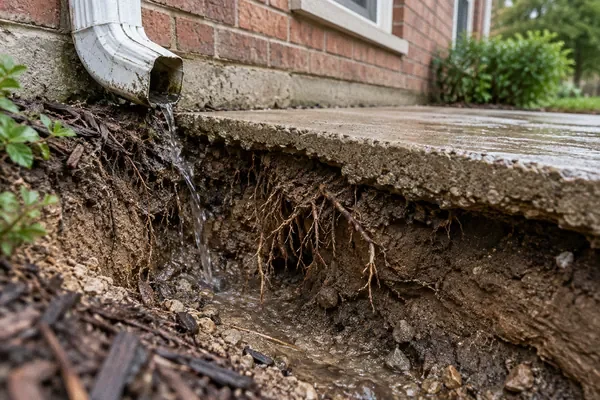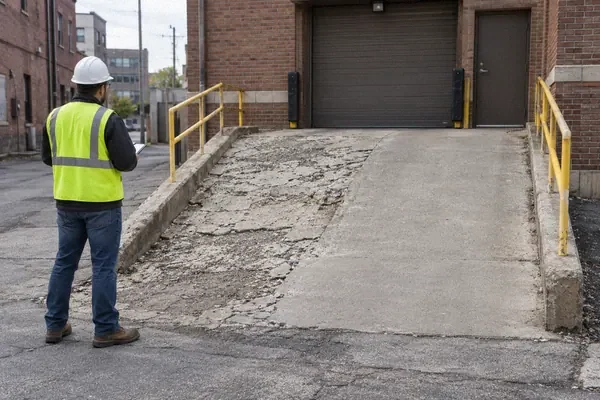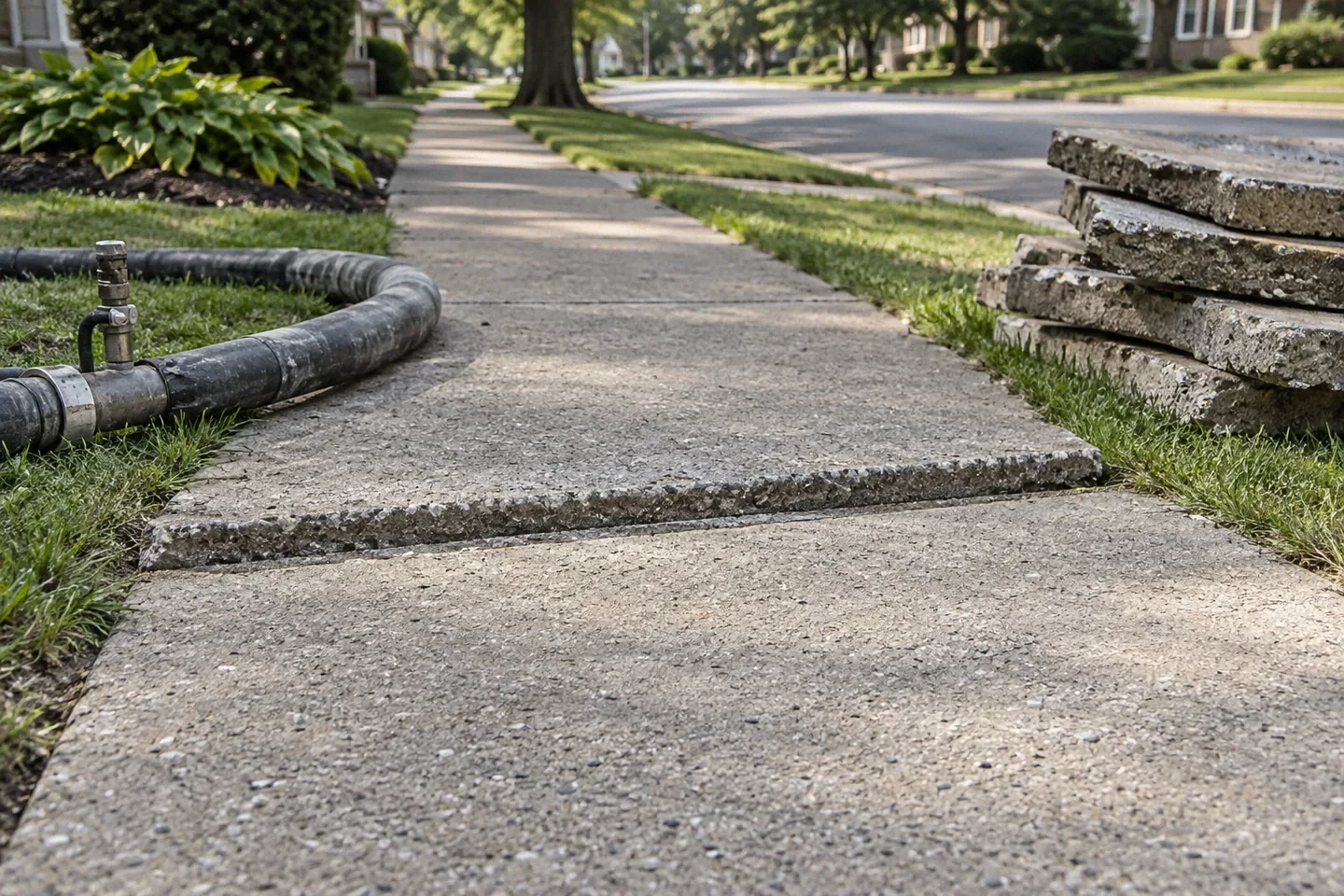
- Assess the slab's integrity
- Set target elevations and drainage
- Compare cause correction and repair
Reddit discussions identify questions; technical guidance comes from the linked primary sources. This article is not a site inspection or an engineered specification. How we research.
Compare outcomes before comparing methods
When one concrete panel sits below another, lifting offers an appealing promise: correct the elevation without demolition. Replacement offers a different promise: start again with new concrete and access to what lies beneath. Neither description tells you whether the method fits the actual condition.
A Reddit homeowner asked whether polyurethane lifting would cost less than replacing a sinking slab. Replies split between lifting and replacement, with some pointing to drainage. The useful question is broader than initial price: which complete scope will achieve the required elevations and address the conditions that caused the problem?
Establish what movement occurred
Ask for a review of the slab, adjoining surfaces and reliable reference points. A visible offset does not automatically show which side moved. Look for cracks, changing gaps, tilted edges and the effect on drainage or normal use. Provide earlier photographs if they exist.
A raised edge may require a different explanation from a uniformly depressed panel. NRMCA CIP 19, Curling of Concrete Slabs discusses deformation associated with differences through a slab. That does not diagnose your concrete, but it is a reminder not to label every elevation difference settlement.
If the slab is structural, elevated or has unfamiliar connections, the review must account for that role. Do not apply a ground-supported walkway lifting example to a slab supporting a building or another structural element.
Understand the distinction between lifting and support restoration
The FHWA Concrete Pavement Preservation Guide distinguishes filling verified support voids from raising settled concrete. It also emphasizes evaluating the underlying causes. Its highway guidance is not a residential installation manual, but it helps explain why a proposal should state whether the goal is restoring support, changing elevation or both.
Ask the lifting contractor what findings make the slab a candidate. How intact is it? What target elevations are achievable? What uncertainties remain below it? How will the process account for adjacent structures or connected concrete? A method name such as foam or mudjacking does not answer those questions.
Do not treat an injection material's strength claim as proof that the entire repair will succeed. The material, placement, support conditions and ongoing exposure form a system. The proposal should explain that system in terms of your slab.
Replacement must correct more than the appearance
Replacement gives access to the area beneath the concrete, but that opportunity matters only if the scope uses it appropriately. Ask how the supporting ground will be evaluated and prepared, what drainage changes are included and how the new joints and interfaces will be designed.
A quotation that says remove and replace in kind may leave an important ambiguity if the original geometry caused the complaint. Request the target elevations and intended water route. New concrete poured to an unsuitable arrangement can reproduce an old problem.
Also discuss adjacent damage and appearance. Demolition access, retained steps, landscaping and older concrete boundaries affect the project. The replacement surface may look different from neighboring concrete, which should be acknowledged before work begins.
Set the target result in measurable terms
The goal might be removing an offset, restoring access to a doorway or establishing drainage away from a building. These are not always identical to making the slab perfectly level. Ask the contractor to explain the required relationship between the repaired panel and its surroundings.
If water has been pooling, identify the destination after repair. If a door or step is involved, check the available height and functional constraints. A small elevation change can affect several nearby elements, so the plan should account for them together.
Agree on how the result will be reviewed. Photographs alone may not establish elevations. The contractor should provide the measurements or other evidence appropriate to the objective and explain any practical limits on precision or appearance.
Compare complete proposals
| Issue | Lifting proposal | Replacement proposal |
|---|---|---|
| Existing slab | Why is it a suitable candidate? | Why is removal preferable? |
| Support | What condition is being addressed? | How will exposed support be evaluated? |
| Elevations | What can be achieved without unwanted effects? | What new layout and heights are proposed? |
| Drainage | What continuing water problem is corrected? | Where will runoff go after reconstruction? |
| Finish | What holes, patches or cracks remain visible? | How will new concrete meet old surfaces? |
| Uncertainty | What findings could stop or alter the work? | How are unexpected ground conditions handled? |
The comparison should include return to use, access and maintenance. Ask each contractor to identify exclusions so a lower price is not mistaken for a more complete solution.
A hypothetical small walkway
Imagine a hypothetical intact walkway panel that has dropped near a step. A lifting contractor evaluates it and proposes a defined elevation correction, while a replacement contractor proposes removal and improved preparation. The owner also learns that runoff at the edge needs correction. Comparing lifting alone against replacement plus drainage would not be fair.
Once both scopes address the same required outcome, the owner can weigh disruption, appearance and price. In another hypothetical case, the panel is heavily cracked and the assessment finds that retaining it is unsuitable. The same low-disruption method may no longer be the sensible option. The decision follows the slab's condition rather than a universal preference for one technology.
Ask how recurrence will be handled
Review the written warranty and its exclusions, but do not use warranty length as the only quality measure. Ask what happens if the panel moves again and what evidence would be needed to investigate. A long promise is less useful if the proposal never addresses the known source of water or support concern.
Keep the initial condition map, repair targets and completion record. These documents establish what was intended and what was achieved, making future maintenance or evaluation more straightforward.
Choose the method after the assessment
Request an explanation of why the selected approach suits the actual slab and what would make it unsuitable. Lifting can preserve usable concrete in appropriate conditions; replacement can provide a broader correction when justified. Neither should be selected solely from a photograph or an advertised price. Establish the movement, target result and underlying conditions first, then compare complete scopes that answer the same problem.
Related questions
Is foam lifting always better than replacing a small slab?
No. Slab condition, access, movement cause and the required result can make either option unsuitable or uneconomical.
Does a raised corner always mean the rest of the slab settled?
No. Curling and other movement patterns can affect elevations. The condition needs to be identified before choosing a lifting method.
Research references
- primary · full
NRMCA CIP 19 - Curling of Concrete Slabs - primary · search-excerpt
FHWA Concrete Pavement Preservation Guide, Second Edition - reddit · search-excerpt
Concrete slab sinking