- Walk the agreed boundaries
- Record remaining items
- Reconcile the completion record
Reddit discussions identify questions; technical guidance comes from the linked primary sources. This article is not a site inspection or an engineered specification. How we research.
Prepare the documents before walking the site
Bring the final accepted scope, current drawing, approved changes and selected finish information. Review the payment ledger separately so you know whether the invoice under discussion is a phase payment or the final balance. A walkthrough becomes less useful when everyone is trying to remember which proposal was accepted.
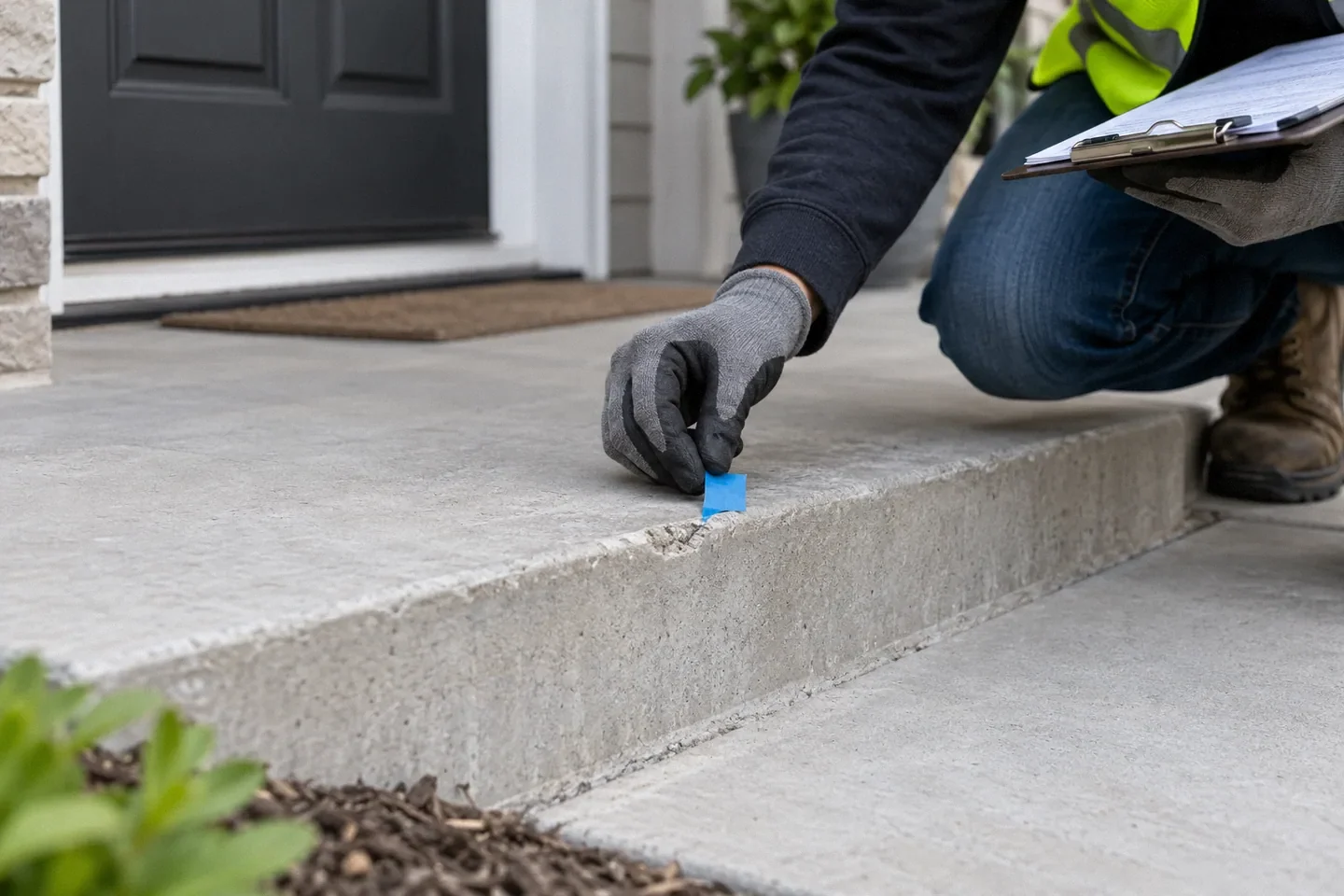
Mark the included areas on a simple plan. Walk them in a consistent order, starting at a fixed reference point such as the garage door or patio entry. Include small connectors, borders and transition areas that are easily overlooked when attention goes to the largest slab.
A Reddit discussion about a credit and completion signoff illustrates the confusion that occurs when the owner does not know which company or document controls acceptance. Use your own contract to establish that before the meeting.
Separate observations from conclusions
Write what you see: a marked area remains uncompleted, a form is still present, a promised document is missing or a finish differs from the selected sample. Avoid immediately labeling every observation defective. Some items need explanation, some need technical review and some are straightforward remaining work.
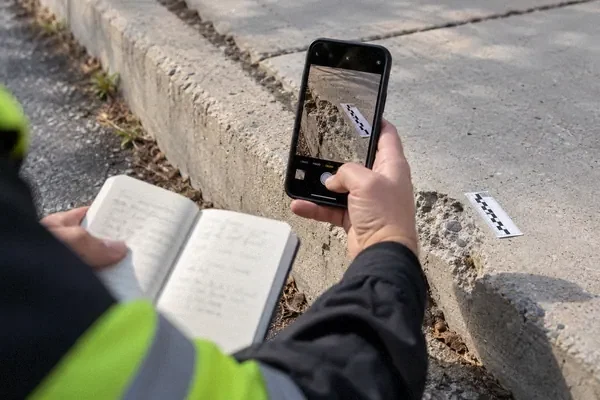
Photograph each item with both a wide view and a detail view. Number it on the plan so the contractor can find it later. A close photograph without location or scale may not help the person returning to the site.
Do not improvise damaging tests to demonstrate dissatisfaction. If drainage performance or another technical criterion is disputed, agree on a suitable assessment method with the responsible professional. A casual experiment may not replicate the relevant conditions and can create a new disagreement about what it proves.
Build a punch list that can be closed
| Item | Useful entry |
|---|---|
| Location | North edge beside the gate, marked as item 3 |
| Observation | Temporary form remains in the included work area |
| Contract reference | Cleanup and form-removal scope |
| Proposed action | Contractor to confirm removal and restoration plan |
| Responsibility | Named project contact |
| Target and status | Agreed return date, then written completion confirmation |
Keep aesthetic preferences separate from deviations from the agreed selection. The contractor can evaluate a request for a different appearance, but it may not have the same status as an omitted contract item. A clear list makes that distinction visible without dismissing the owner's concern.
If a proposed remedy changes the surface or layout, request enough detail to understand the result. “Fix it” may mean a local patch to one person and replacement to another. Identify any sample or mockup needed before approving visible corrective work.
Review the site beyond the slab
Look at the access route used by equipment and the areas identified for restoration. Check whether included debris, temporary barriers and leftover materials have been addressed. Confirm who is responsible for any remaining protection or access restrictions and when those responsibilities end.
Ask for the records promised by the contract: product information, care instructions, warranty details, delivery or testing documents where included and applicable approval records. Do not assume every residential job must produce the same technical dossier. Compare the handover with the actual project requirements.
The FTC recommends resolving completion before final payment. How that applies to a disputed invoice still depends on your contract and local law; the walkthrough should clarify facts rather than serve as a universal withholding formula.
Hypothetical example: five items, three different decisions
Suppose an owner lists five concerns on a new patio. Two involve remaining cleanup, one concerns a selected border detail, one is a question about a visible surface mark and one is a request to extend the patio beyond the original boundary.
During the walkthrough, the contractor agrees to complete the cleanup, checks the border against the approved drawing and proposes an assessment of the surface mark. The extension is recorded as a new request requiring a separate price. Each item now has a distinct next action.
This is more effective than a single demand to “make the patio acceptable.” It also prevents the contractor from treating every concern as a new preference when some may be documented unfinished work.
Read the signoff language
A completion form may acknowledge a visit, list remaining items, approve a payment or contain a broader release. Read the actual words. If unresolved matters exist, do not assume that writing them in a separate email changes the effect of the document you are signing.
For California projects, the CSLB contract guide provides relevant contract context. Other states require their own review. Obtain legal advice where a proposed settlement or release could materially affect a significant claim.
After the meeting, send the agreed list and ask the contractor to confirm it. When an item is completed, photograph the result and record the date. Keep the original list as well as the closed version so the history remains understandable.
Does a final walkthrough prove the slab meets structural requirements?
No. A visual owner walkthrough cannot establish hidden reinforcement, concrete strength or design adequacy. Those questions require the appropriate project records and qualified professional review.
Must every small appearance concern be resolved by replacement?
No. The appropriate response depends on the agreed finish, the nature of the condition and a suitable assessment. Ask for a specific proposed remedy and its expected limitations before deciding.
End the walkthrough with a dated list, assigned responsibilities and a clear record of what is complete. That gives both parties a practical route to close the project without confusing observation, payment and legal acceptance.
Research references
- primary · full
FTC: How To Avoid a Home Improvement Scam - primary · full
CSLB: Terms of Agreement - reddit · search-excerpt
Is it reasonable to expect to be paid in full if work is not completed? - reddit · search-excerpt
Update: being offered a credit