- Define countertop geometry
- Match mix to casting system
- Resolve supports and curing
Reddit discussions identify questions; technical guidance comes from the linked primary sources. This article is not a site inspection or an engineered specification. How we research.
An outdoor countertop is not simply a small patio elevated onto cabinets. Its thin sections, edges, openings, overhangs, supports, and exposed finish create a different set of decisions.
A Reddit discussion about concrete for outdoor countertops compared different bagged products and casting systems. The useful question is not which bag has the largest strength number. It is which documented system fits the countertop you intend to build.
Draw the geometry before selecting material
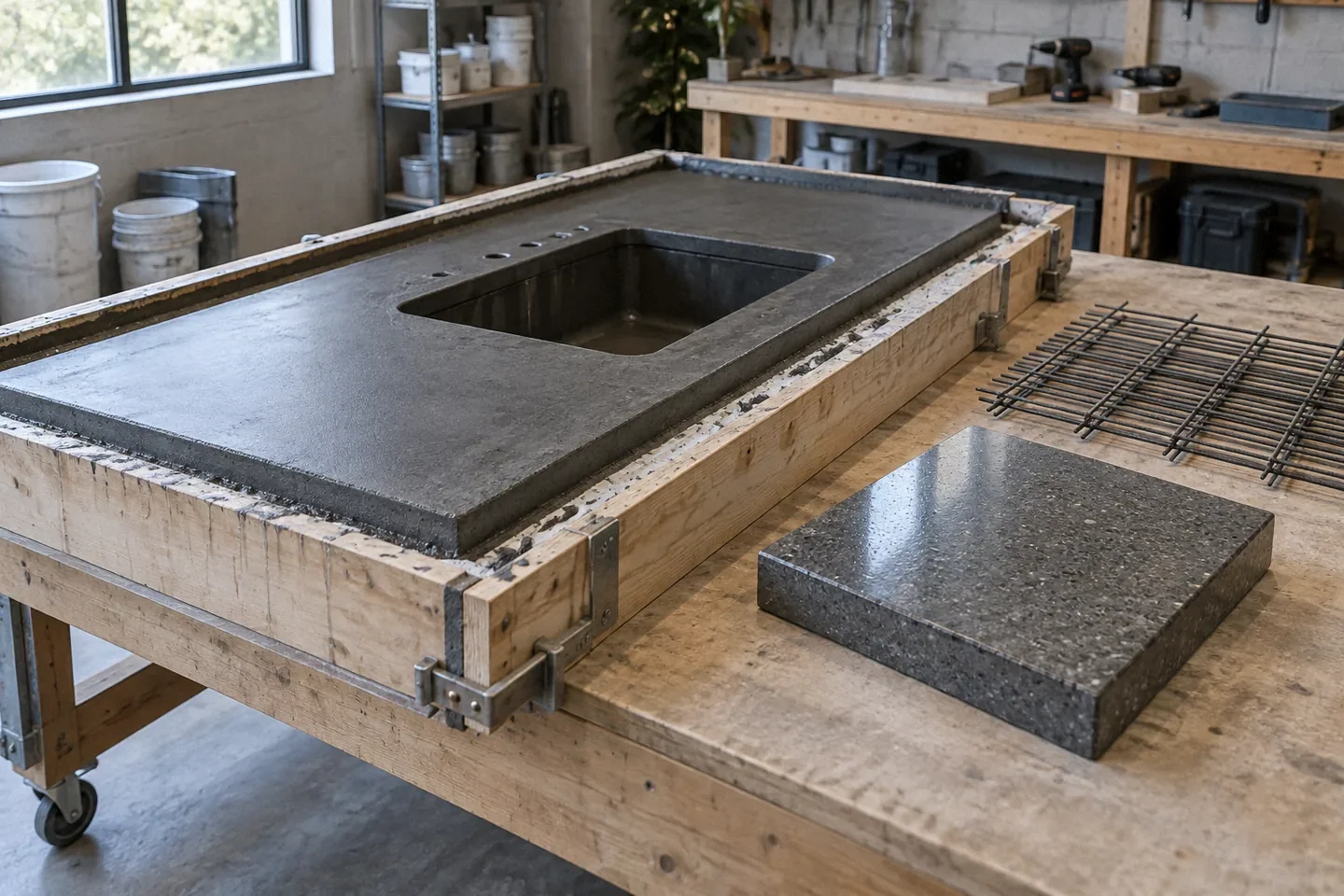
Show the overall dimensions, thickness, sink and appliance openings, unsupported areas, joints, and edge profile. Include the supporting structure rather than drawing only the visible top.
Thin areas around an opening may be more demanding than the broad field. A decorative thick-looking edge can also differ from the actual structural section.
If the design includes significant spans, cantilevers, unusual loads, or uncertain support, obtain appropriate design assistance. A product bag cannot establish those details for every possible countertop.
Choose for the casting process
Will the top be precast and moved into place or cast in place? How will the forms be supported, and how will concrete reach every part of them?
QUIKRETE's current countertop-product page describes a purpose-formulated flowable product for countertop applications. That is more directly relevant than selecting ordinary concrete solely by PSI.
Use the current data sheet for the exact product supplied. Older documents and similarly named products may list different properties or handling instructions, so do not combine them into one assumed recipe.
Flow is not permission to add unlimited water
A mixture designed to flow in countertop forms should be mixed according to its documented instructions. If it does not behave as expected, check the product, water measurement, mixer, and procedure rather than simply making it wetter.
Record the amount of water and product in each batch. A visually similar mixture can still differ if batches are adjusted by feel.
Do not independently add admixtures, cement, or aggregate while continuing to rely on the original product's published properties. Obtain manufacturer guidance for any proposed modification.
A hypothetical outdoor kitchen
Suppose an owner plans a long countertop with a sink opening and a seating overhang. They choose a high-strength bag because a friend used it for a thick garden table.
The project review identifies different geometry and support. The friend’s example does not establish that the proposed thin sections and overhang are suitable. The owner resolves the support and reinforcement design, then selects a mixture compatible with that arrangement and casting method.
A small sample is made using the planned edge form, color, and finish. It reveals a visible form seam and a color different from the screen image. Those are inexpensive discoveries compared with finding them after casting the full top.
Evaluate the system as a whole
| Component | Question to answer |
|---|---|
| Mixture | Is countertop use documented? |
| Aggregate and flow | Can it fill the actual section and details? |
| Forms | Will they hold shape and remain supported? |
| Reinforcement | What design and placement are required? |
| Openings | How are narrow sections and transitions detailed? |
| Curing | What procedure applies to this product? |
| Handling | How will precast work be moved, if applicable? |
| Surface treatment | Is it suited to the intended outdoor use? |
The table prevents one attractive product claim from standing in for the entire design.
Plan curing and demolding from the exact instructions
Do not choose a universal demolding time from an old tutorial. Product formulation, conditions, element geometry, and handling demands matter.
The QUIKRETE countertop data sheet provides product-specific construction guidance. Confirm that it corresponds to the supplied product and follow any updated manufacturer directions.
Demolding and placing the countertop into service are separate decisions. A piece ready for one operation may not be ready for an unsupported lift, installation load, or normal use.
Account for outdoor conditions
Describe sun, rain, temperature exposure, and the intended cleaning routine when choosing the final surface system. A treatment suitable for one indoor application is not automatically appropriate outdoors.
If food-contact suitability is relevant, obtain explicit documentation for the selected cured surface product and intended use. Do not infer it from a general “concrete sealer” label.
Discuss maintenance and appearance expectations. Concrete may appeal because of its character, but the owner should still know what cleaning and future treatment the actual system requires.
Make the sample useful
Include the proposed pigment, form face, edge, consolidation method, and final treatment. Review it after the relevant curing and finishing sequence rather than comparing only freshly wet concrete.
A sample does not replace structural design. It tests appearance and constructability within the proposed system.
Keep the product names and mixing notes. If the sample is approved, changing the materials afterward weakens its value as a reference.
Buy the documented process
A purpose-designed mixture can simplify material selection, but it does not supply the countertop's supports, reinforcement, forms, or installation plan.
Resolve those items before ordering enough bags for the full job. The most useful purchase is a complete, repeatable casting system with an approved appearance, not simply the strongest label on the shelf.
Verify appliance openings before casting
Use the actual sink and appliance installation information when locating openings. Confirm model numbers and obtain the required templates before the forms are finalized. A countertop cast around an assumed dimension can create an expensive fit problem even when the concrete itself is satisfactory. Record any change in appliance selection before approving the final form layout.
Frequently asked questions
Can ordinary concrete make a countertop?
It may be possible in a suitable designed system, but suitability should be demonstrated rather than assumed. Product-specific countertop guidance is a better starting point.
Does higher PSI justify a longer overhang?
No. Have the actual geometry, support, and reinforcement evaluated. A compressive-strength number is not an overhang design.
Research references
- primary · search-excerpt
QUIKRETE Countertop Mix Current Product Page - primary · search-excerpt
QUIKRETE Countertop Mix data sheet - reddit · search-excerpt
Concrete for countertops