- Identify the stage at risk
- Prepare cover and runoff control
- Assign the proceed-or-delay decision
Reddit discussions identify questions; technical guidance comes from the linked primary sources. This article is not a site inspection or an engineered specification. How we research.
A forecast showing a chance of rain does not answer whether a concrete pour should proceed. It raises a sequence of questions: when might rain arrive, how intense could it be, what stage will the slab have reached, and what protection can the crew actually deploy?
A Reddit owner described concrete placed and finished during cold rain. That account combines several variables. This article focuses on planning before such a situation develops, not diagnosing the finished concrete remotely.
Before placement, check the whole site
Review the prepared support, access route, forms, and discharge area. Rain can change more than the top of the slab: it can affect the path used by workers and equipment or create water movement through the work area.
Identify where roof runoff, downspouts, slopes, and nearby drains send water. A small shower over the slab may be less significant than concentrated runoff arriving from a much larger area.
If the site is no longer ready, reassess before releasing the delivery. A forecast is uncertain, but visible unsuitable conditions should not be ignored merely because the order is already scheduled.
During placement, preserve a controlled process
The crew needs a way to protect the work without losing control of placing, screeding, and access. Discuss who handles covers and who remains responsible for the concrete.
Avoid a plan that requires every worker to abandon the placement at once. Protection materials should be staged and manageable for the actual slab geometry.
The NRMCA flatwork guide provides the relevant context for surface finishing and moisture. The owner should not assume that water landing on fresh concrete can simply be worked into the surface.
Distinguish an unfinished surface from curing
A surface still being finished has different needs from one receiving its selected curing treatment. “Concrete likes water” is too broad to decide what to do at every stage.
NRMCA CIP 11 explains curing as deliberate control of conditions after placement. Unplanned rainfall is not automatically equivalent to a continuous, appropriate curing method.
Likewise, protection against rain does not eliminate the need for curing once the finish is complete. The plan should connect those stages instead of treating one as a replacement for the other.
A hypothetical changing forecast
Suppose a patio pour is scheduled for the morning, with showers expected late in the day. The crew plans direct discharge and has protection ready.
The forecast changes overnight to earlier, heavier rain. The contractor reviews whether the initial placement and finishing can still be managed under the revised conditions, including runoff from the house roof.
The decision may be to reschedule. If the team proceeds, it should be because the actual plan and resources are suitable, not because the original forecast looked acceptable when the order was made.
This example does not set a universal rain probability or intensity cutoff. It shows how a change in timing should trigger a fresh decision.
Organize the response by stage
| Stage | Main planning question |
|---|---|
| Prepared site | Has rain changed support or access readiness? |
| Active placement | Can the operation remain controlled? |
| Unfinished surface | Is suitable protection ready and deployable? |
| Completed finish | How does protection connect with curing? |
| Later exposure | What product and project requirements apply? |
| After an unexpected event | What records and assessment are needed? |
A stage-based plan is more useful than a blanket statement that rain either never matters or always causes failure.
Covers require a workable arrangement
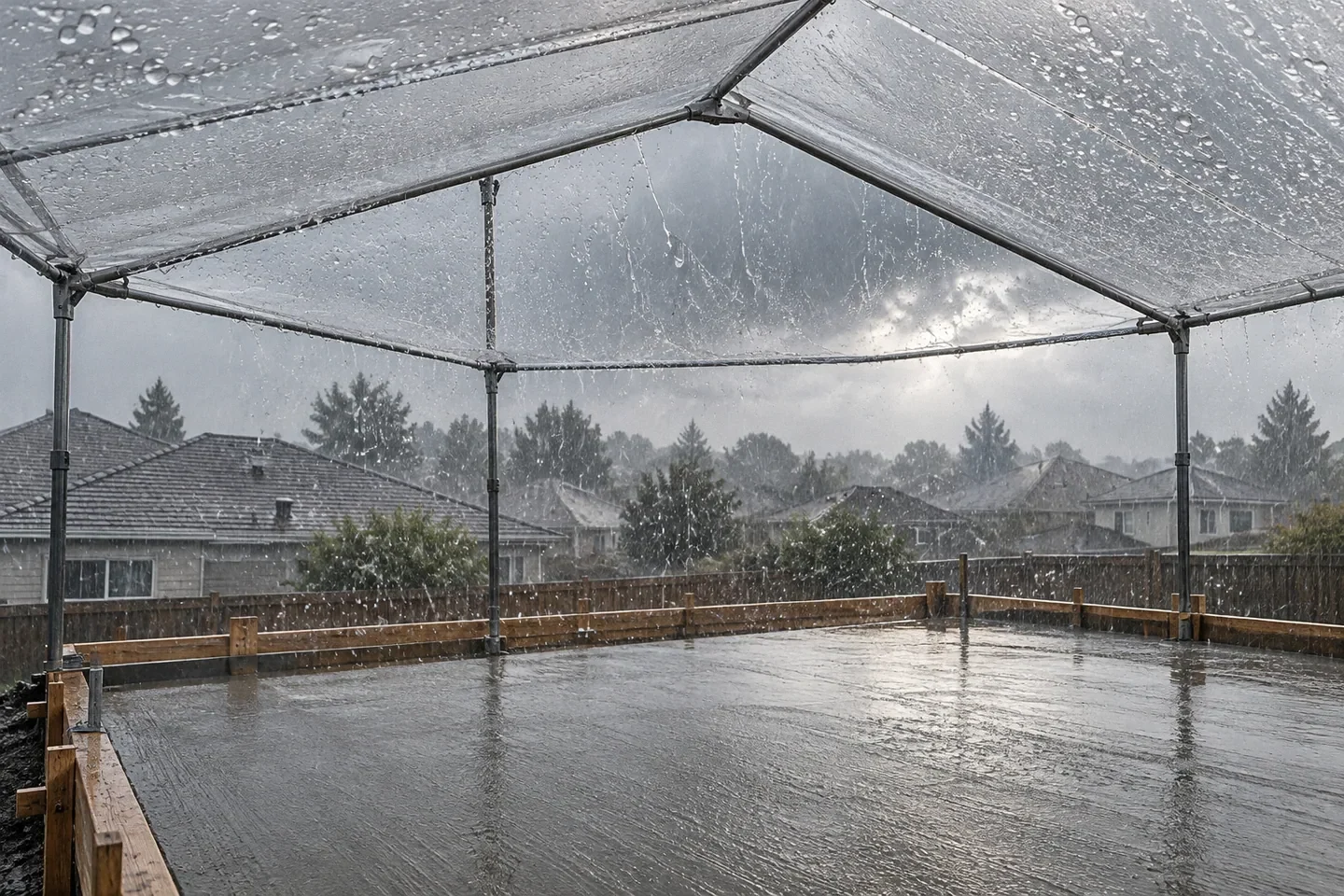
Think about where covers are stored, how they are handled, and how water is kept from concentrating on vulnerable areas. The crew should not discover during a shower that the material is too small or impossible to position.
Protect adjacent property and provide a planned route for runoff. Do not divert water into another building opening or unresolved low area.
For decorative work, ask how temporary protection may affect appearance and how the selected system should be used. A finish-sensitive surface may need more deliberate planning than an ordinary utility pad.
Assign the decision to one responsible contact
The person coordinating the pour should know who can delay dispatch, authorize a schedule change, and direct the site's response. Multiple people giving contradictory instructions can waste the limited time available.
Agree on a communication method and the point at which readiness is confirmed. If a supplier has cancellation or waiting terms, understand them beforehand.
Financial inconvenience is real, but it does not establish technical readiness. Compare the cost of rescheduling with the actual risks and available controls rather than treating the delivery appointment as irreversible.
Record an unexpected event without diagnosing it
If rain arrives unexpectedly, record timing, duration, the work stage, protection used, and any changes to the process. Keep photographs with enough context to show the area and conditions.
Those records support later assessment. They do not prove from appearance alone that the concrete is sound or defective.
If there is a concern after placement, obtain an appropriate evaluation based on the actual condition and requirements. Avoid both immediate demolition demands and categorical reassurance based only on the fact that rain occurred.
Make weather part of the construction plan
Ask the installer to explain the go-or-delay decision, protection setup, runoff management, and curing transition before the pour. This is particularly useful for work near buildings or with decorative surfaces.
The next step is to identify the stage most likely to coincide with rain and confirm that the crew can manage it. A practical staged plan is stronger than hoping the shower arrives at a convenient moment.
Frequently asked questions
Does all rain damage concrete?
No. The stage, intensity, protection, and actual operations determine the concern. Do not infer a diagnosis from rainfall alone.
Can rainwater simply be troweled into the surface?
Do not use added surface water as a finishing shortcut. Follow an appropriate protection and finishing response.
Research references
- primary · full
NRMCA CIP 14 Finishing Concrete Flatwork - primary · search-excerpt
NRMCA CIP 11 Curing In-Place Concrete - reddit · search-excerpt
pour concrete in +1C with rain