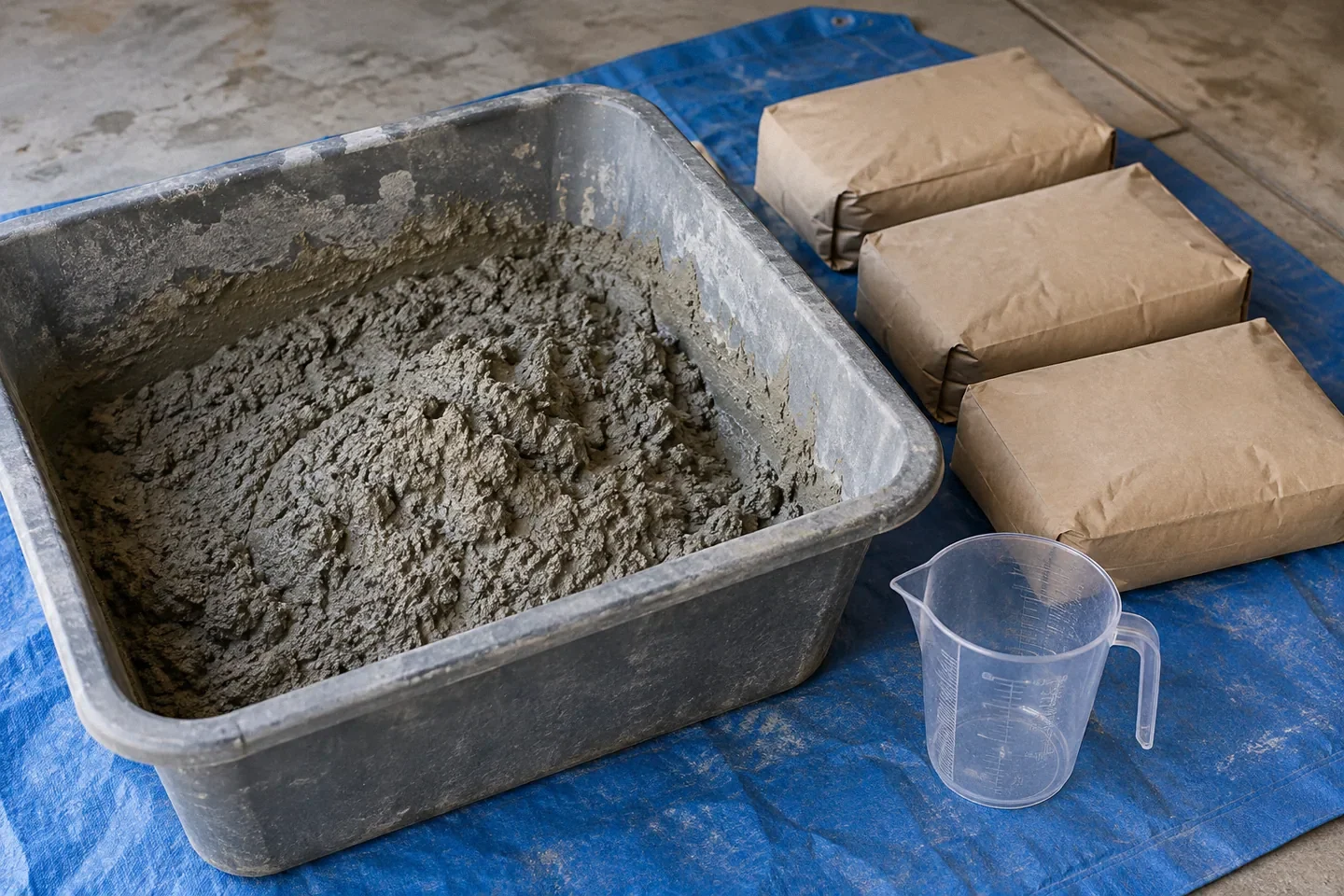
- Measure each batch consistently
- Time loading through transport
- Assign separate placement roles
Reddit discussions identify questions; technical guidance comes from the linked primary sources. This article is not a site inspection or an engineered specification. How we research.
A small mixer can make bagged concrete manageable, but it does not automatically make the batches consistent. Consistency comes from measured ingredients, a repeated procedure, and a placement plan that does not force rushed improvisation.
A Reddit owner facing twelve or thirteen mixer loads focused on slowing the material down. Before considering a set-control product, it is worth checking the full production cycle. The bottleneck may be loading or transport rather than the mixture itself.
Start with the exact product
Read the current bag and data sheet for the product you actually bought. Do not apply a water quantity from a different bag weight, fast-setting product, or countertop mixture.
The QUIKRETE Concrete Mix data sheet illustrates how a manufacturer documents yield, mixing, and application requirements for a specific product. It is not a universal recipe for every packaged concrete.
Check that the stored bags remain usable and that the quantity matches the planned volume. Damaged or moisture-affected material should not be quietly mixed into production to avoid a store trip.
Calculate batches from usable yield
Determine required volume from the actual forms and planned allowance. Divide by the selected product's stated yield to establish the bag quantity.
Then determine how many bags the mixer can appropriately handle per batch. Drum volume and practical mixing capacity are not necessarily the same thing; use the equipment and product instructions.
Round the production plan into batches that can be measured consistently. A final partial batch needs a deliberate measurement method, not a casual fraction of an already opened bag.
Measure water with a repeatable method
Use a suitable marked container or another controlled measuring method. Assign one person to track the amount so two helpers do not each add what they assume is missing.
Keep the measuring system visible and understandable. A hose operated for a guessed number of seconds is difficult to repeat when pressure or attention changes.
If the product permits a range, understand the intended procedure for reaching the appropriate consistency within that range. Do not interpret it as permission to add more whenever transport becomes inconvenient.
A hypothetical ten-batch placement
Suppose a crew plans ten batches for a small slab. Their first timed test measures only the period when the drum is turning and suggests the pour will be easy.
A second test includes carrying bags, measuring water, loading, discharging, moving the wheelbarrow, placing material, and returning. The full cycle is much longer.
The crew reorganizes staging and assigns separate mixing, transport, and placing responsibilities. They also make sure an experienced person can manage the surface while later batches continue.
The improvement comes from production planning, not from making every batch wetter. The actual timing now supports a more realistic decision about whether bags remain the right method.
Keep a batch sheet
| Batch record | Why it helps |
|---|---|
| Product and bag weight | Prevents mixing unlike assumptions |
| Number of bags | Connects material to expected yield |
| Water measurement | Makes the procedure repeatable |
| Mixing start and discharge | Reveals cycle time and delays |
| Placement location | Helps trace the sequence |
| Unusual event | Records interruptions or product concerns |
A simple tally sheet is enough for many small jobs. The goal is to prevent uncertainty, not create paperwork that no one can maintain while working.
Arrange the work area deliberately
Stage bags so loading does not block the path used to move wet concrete. Keep the water supply and measuring container accessible without creating a trip hazard.
Protect the material from weather and plan how empty bags and waste are handled. A cluttered staging area makes a demanding task slower and less predictable.
Check the mixer before the pour. Confirm power or fuel, access, discharge height, and the manufacturer's operating instructions. Discovering a missing connection after several bags are opened is avoidable.
Do not make the finisher the emergency helper
Someone needs to manage the concrete already placed while later batches are still being produced. If every delay pulls the finisher away, the sequence becomes unstable.
Write the roles down before starting. Identify who can cover a short interruption without abandoning another essential task.
If the available crew cannot support the planned volume, consider ready mix, appropriate access equipment, or a revised placement plan with properly considered joints. An unplanned pause across the slab is not a substitute for that decision.
Keep old and fresh material decisions separate
A batch becoming difficult to handle may be outside the intended working conditions or timing. Do not automatically combine it with a fresh batch or add water to restore its appearance.
Follow the product's instructions and obtain manufacturer guidance if the situation is unclear. The fact that material can be made to move again does not establish that the original performance information still applies.
Avoid adding household chemicals or improvised admixtures to solve a schedule problem. Change the logistics or choose a supported product system instead.
Prepare the finish and cure before mixing
Set out finishing tools and curing materials in advance. Confirm the surface requirements, access, and any joint plan.
A successful batch process only gets concrete into the forms. The project still needs the appropriate finishing and protection sequence.
The next step is a timed rehearsal using the actual mixer, route, and crew roles. If the cycle is not credible before the pour, it will not become easier when fresh concrete is waiting.
Frequently asked questions
Should every batch use the same measured water?
Use the exact product's instructions and permitted procedure. Consistency means controlled measurement, not copying another product's recipe.
Can water revive a stiff older batch?
Do not assume so. Follow the product's working-time and retempering directions, and resolve the underlying delay.
Research references
- primary · search-excerpt
QUIKRETE Concrete Mix 1101 data sheet - reddit · search-excerpt
Need to slow cure time on a small slab